 Add to Chrome
 Add to Firefox
 Add to Edge
BROS: Bias-Corrected Randomized Subspaces for Memory-Efficient Single-Loop Bilevel Optimization
May 11, 2026
Stochastic bilevel optimization (SBO) has become a standard framework for hyperparameter learning, data reweighting, representation learning, and data-mixture optimization in deep learning. Existing exact single-loop SBO methods and memory-efficient surrogate SBO methods either create severe memory pressure for large lower-level neural networks or lack competitive convergence guarantees under standard assumptions. In this paper, we propose BROS, a memory-efficient single-loop SBO method with the same convergence rate order as exact single-loop SBO methods. BROS performs lower and auxiliary updates in randomized subspaces with a Rademacher bi-probe correction that recovers an unbiased Hessian-action estimator. We prove that BROS preserves the $\mathcal O(\varepsilon^{-2})$ sample complexity of MA-SOBA for finding an $\varepsilon$-stationary point under only standard assumptions. Experiments on hyper-data cleaning, data-mixture learning, hyper-representation learning, and ViT sample reweighting show that BROS reduces peak memory by up to 44.9% while closely matching full-space baseline performance.

Blinded Multi-Rater Comparative Evaluation of a Large Language Model and Clinician-Authored Responses in CGM-Informed Diabetes Counseling
Apr 16, 2026Continuous glucose monitoring (CGM) is central to diabetes care, but explaining CGM patterns clearly and empathetically remains time-intensive. Evidence for retrieval-grounded large language model (LLM) systems in CGM-informed counseling remains limited. To evaluate whether a retrieval-grounded LLM-based conversational agent (CA) could support patient understanding of CGM data and preparation for routine diabetes consultations. We developed a retrieval-grounded LLM-based CA for CGM interpretation and diabetes counseling support. The system generated plain-language responses while avoiding individualized therapeutic advice. Twelve CGM-informed cases were constructed from publicly available datasets. Between Oct 2025 and Feb 2026, 6 senior UK diabetes clinicians each reviewed 2 assigned cases and answered 24 questions. In a blinded multi-rater evaluation, each CA-generated and clinician-authored response was independently rated by 3 clinicians on 6 quality dimensions. Safety flags and perceived source labels were also recorded. Primary analyses used linear mixed-effects models. A total of 288 unique responses (144 CA and 144 clinician) generated 864 ratings. The CA received higher quality scores than clinician responses (mean 4.37 vs 3.58), with an estimated mean difference of 0.782 points (95% CI 0.692-0.872; P<.001). The largest differences were for empathy (1.062, 95% CI 0.948-1.177) and actionability (0.992, 95% CI 0.877-1.106). Safety flag distributions were similar, with major concerns rare in both groups (3/432, 0.7% each). Retrieval-grounded LLM systems may have value as adjunct tools for CGM review, patient education, and preconsultation preparation. However, these findings do not support autonomous therapeutic decision-making or unsupervised real-world use.
Rethinking Token-Level Policy Optimization for Multimodal Chain-of-Thought
Mar 24, 2026Multimodal Chain-of-Thought (CoT) reasoning requires large vision-language models to construct reasoning trajectories that interleave perceptual grounding with multi-step inference. However, existing Reinforcement Learning with Verifiable Rewards (RLVR) methods typically optimize reasoning at a coarse granularity, treating CoT uniformly without distinguishing their varying degrees of visual grounding. In this work, we conduct a token-level analysis of multimodal reasoning trajectories and show that successful reasoning is characterized by structured token dynamics reflecting both perceptual grounding and exploratory inference. Building upon this analysis, we propose Perception-Exploration Policy Optimization (PEPO), which derives a perception prior from hidden state similarity and integrates it with token entropy through a smooth gating mechanism to produce token-level advantages. PEPO integrates seamlessly with existing RLVR frameworks such as GRPO and DAPO, requiring neither additional supervision nor auxiliary branches. Extensive experiments across diverse multimodal benchmarks demonstrate consistent and robust improvements over strong RL baselines, spanning geometry reasoning, visual grounding, visual puzzle solving, and few-shot classification, while maintaining stable training dynamics. Code: https://github.com/xzxxntxdy/PEPO
Towards Universal Video MLLMs with Attribute-Structured and Quality-Verified Instructions
Feb 13, 2026Universal video understanding requires modeling fine-grained visual and audio information over time in diverse real-world scenarios. However, the performance of existing models is primarily constrained by video-instruction data that represents complex audiovisual content as single, incomplete descriptions, lacking fine-grained organization and reliable annotation. To address this, we introduce: (i) ASID-1M, an open-source collection of one million structured, fine-grained audiovisual instruction annotations with single- and multi-attribute supervision; (ii) ASID-Verify, a scalable data curation pipeline for annotation, with automatic verification and refinement that enforces semantic and temporal consistency between descriptions and the corresponding audiovisual content; and (iii) ASID-Captioner, a video understanding model trained via Supervised Fine-Tuning (SFT) on the ASID-1M. Experiments across seven benchmarks covering audiovisual captioning, attribute-wise captioning, caption-based QA, and caption-based temporal grounding show that ASID-Captioner improves fine-grained caption quality while reducing hallucinations and improving instruction following. It achieves state-of-the-art performance among open-source models and is competitive with Gemini-3-Pro.
ScaleDoc: Scaling LLM-based Predicates over Large Document Collections
Sep 16, 2025Predicates are foundational components in data analysis systems. However, modern workloads increasingly involve unstructured documents, which demands semantic understanding, beyond traditional value-based predicates. Given enormous documents and ad-hoc queries, while Large Language Models (LLMs) demonstrate powerful zero-shot capabilities, their high inference cost leads to unacceptable overhead. Therefore, we introduce \textsc{ScaleDoc}, a novel system that addresses this by decoupling predicate execution into an offline representation phase and an optimized online filtering phase. In the offline phase, \textsc{ScaleDoc} leverages a LLM to generate semantic representations for each document. Online, for each query, it trains a lightweight proxy model on these representations to filter the majority of documents, forwarding only the ambiguous cases to the LLM for final decision. Furthermore, \textsc{ScaleDoc} proposes two core innovations to achieve significant efficiency: (1) a contrastive-learning-based framework that trains the proxy model to generate reliable predicating decision scores; (2) an adaptive cascade mechanism that determines the effective filtering policy while meeting specific accuracy targets. Our evaluations across three datasets demonstrate that \textsc{ScaleDoc} achieves over a 2$\times$ end-to-end speedup and reduces expensive LLM invocations by up to 85\%, making large-scale semantic analysis practical and efficient.
ROAD: Responsibility-Oriented Reward Design for Reinforcement Learning in Autonomous Driving
May 30, 2025Reinforcement learning (RL) in autonomous driving employs a trial-and-error mechanism, enhancing robustness in unpredictable environments. However, crafting effective reward functions remains challenging, as conventional approaches rely heavily on manual design and demonstrate limited efficacy in complex scenarios. To address this issue, this study introduces a responsibility-oriented reward function that explicitly incorporates traffic regulations into the RL framework. Specifically, we introduced a Traffic Regulation Knowledge Graph and leveraged Vision-Language Models alongside Retrieval-Augmented Generation techniques to automate reward assignment. This integration guides agents to adhere strictly to traffic laws, thus minimizing rule violations and optimizing decision-making performance in diverse driving conditions. Experimental validations demonstrate that the proposed methodology significantly improves the accuracy of assigning accident responsibilities and effectively reduces the agent's liability in traffic incidents.
TabGen-ICL: Residual-Aware In-Context Example Selection for Tabular Data Generation
Feb 23, 2025Large Language models (LLMs) have achieved encouraging results in tabular data generation. However, existing approaches require fine-tuning, which is computationally expensive. This paper explores an alternative: prompting a fixed LLM with in-context examples. We observe that using randomly selected in-context examples hampers the LLM's performance, resulting in sub-optimal generation quality. To address this, we propose a novel in-context learning framework: TabGen-ICL, to enhance the in-context learning ability of LLMs for tabular data generation. TabGen-ICL operates iteratively, retrieving a subset of real samples that represent the residual between currently generated samples and true data distributions. This approach serves two purposes: locally, it provides more effective in-context learning examples for the LLM in each iteration; globally, it progressively narrows the gap between generated and real data. Extensive experiments on five real-world tabular datasets demonstrate that TabGen-ICL significantly outperforms the random selection strategy. Specifically, it reduces the error rate by a margin of $3.5\%-42.2\%$ on fidelity metrics. We demonstrate for the first time that prompting a fixed LLM can yield high-quality synthetic tabular data. The code is provided in the \href{https://github.com/fangliancheng/TabGEN-ICL}{link}.
Emerging Microelectronic Materials by Design: Navigating Combinatorial Design Space with Scarce and Dispersed Data
Dec 23, 2024
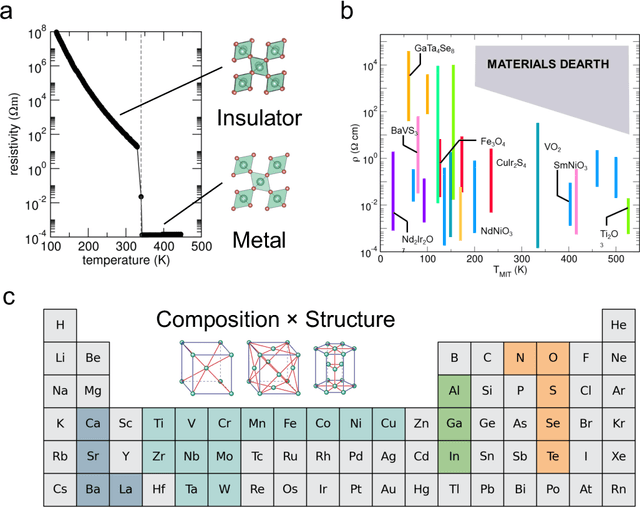
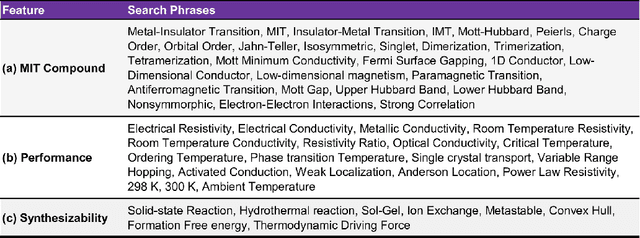
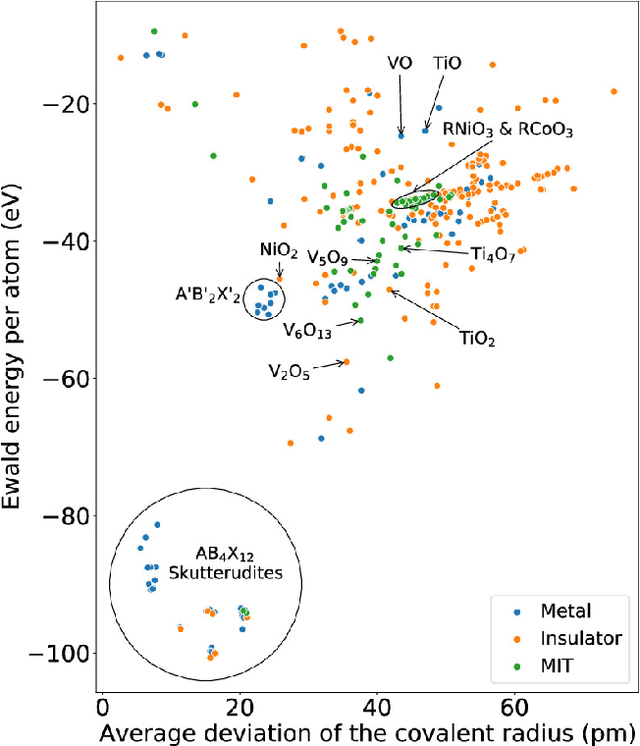
The increasing demands of sustainable energy, electronics, and biomedical applications call for next-generation functional materials with unprecedented properties. Of particular interest are emerging materials that display exceptional physical properties, making them promising candidates in energy-efficient microelectronic devices. As the conventional Edisonian approach becomes significantly outpaced by growing societal needs, emerging computational modeling and machine learning (ML) methods are employed for the rational design of materials. However, the complex physical mechanisms, cost of first-principles calculations, and the dispersity and scarcity of data pose challenges to both physics-based and data-driven materials modeling. Moreover, the combinatorial composition-structure design space is high-dimensional and often disjoint, making design optimization nontrivial. In this Account, we review a team effort toward establishing a framework that integrates data-driven and physics-based methods to address these challenges and accelerate materials design. We begin by presenting our integrated materials design framework and its three components in a general context. We then provide an example of applying this materials design framework to metal-insulator transition (MIT) materials, a specific type of emerging materials with practical importance in next-generation memory technologies. We identify multiple new materials which may display this property and propose pathways for their synthesis. Finally, we identify some outstanding challenges in data-driven materials design, such as materials data quality issues and property-performance mismatch. We seek to raise awareness of these overlooked issues hindering materials design, thus stimulating efforts toward developing methods to mitigate the gaps.
TabDiff: a Multi-Modal Diffusion Model for Tabular Data Generation
Oct 29, 2024
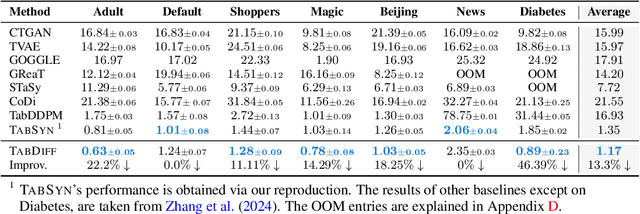


Synthesizing high-quality tabular data is an important topic in many data science tasks, ranging from dataset augmentation to privacy protection. However, developing expressive generative models for tabular data is challenging due to its inherent heterogeneous data types, complex inter-correlations, and intricate column-wise distributions. In this paper, we introduce TabDiff, a joint diffusion framework that models all multi-modal distributions of tabular data in one model. Our key innovation is the development of a joint continuous-time diffusion process for numerical and categorical data, where we propose feature-wise learnable diffusion processes to counter the high disparity of different feature distributions. TabDiff is parameterized by a transformer handling different input types, and the entire framework can be efficiently optimized in an end-to-end fashion. We further introduce a multi-modal stochastic sampler to automatically correct the accumulated decoding error during sampling, and propose classifier-free guidance for conditional missing column value imputation. Comprehensive experiments on seven datasets demonstrate that TabDiff achieves superior average performance over existing competitive baselines across all eight metrics, with up to $22.5\%$ improvement over the state-of-the-art model on pair-wise column correlation estimations. Code is available at https://github.com/MinkaiXu/TabDiff.
Diffusion-nested Auto-Regressive Synthesis of Heterogeneous Tabular Data
Oct 28, 2024Autoregressive models are predominant in natural language generation, while their application in tabular data remains underexplored. We posit that this can be attributed to two factors: 1) tabular data contains heterogeneous data type, while the autoregressive model is primarily designed to model discrete-valued data; 2) tabular data is column permutation-invariant, requiring a generation model to generate columns in arbitrary order. This paper proposes a Diffusion-nested Autoregressive model (TabDAR) to address these issues. To enable autoregressive methods for continuous columns, TabDAR employs a diffusion model to parameterize the conditional distribution of continuous features. To ensure arbitrary generation order, TabDAR resorts to masked transformers with bi-directional attention, which simulate various permutations of column order, hence enabling it to learn the conditional distribution of a target column given an arbitrary combination of other columns. These designs enable TabDAR to not only freely handle heterogeneous tabular data but also support convenient and flexible unconditional/conditional sampling. We conduct extensive experiments on ten datasets with distinct properties, and the proposed TabDAR outperforms previous state-of-the-art methods by 18% to 45% on eight metrics across three distinct aspects.